Showing posts with label boulder zoom whitening. Show all posts

Tuesday, August 26, 2008

Icecapades - Boulder Teeth Whitening & Porcelain Veneers

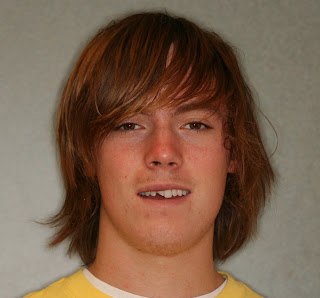
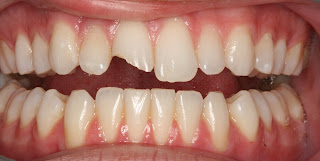
Ice is one of the hazards of winter that has slipped us all up at some time or another. Adam was no exception to this. He slipped and fell hitting his face on the ice. His face took the impact of the fall and tooth #8 (upper right front tooth) was severely broken. He immediately sought treatment from Dr. Adler of Adler Cosmetic & Family Dentistry. Dr. Adler used x-rays and images from the interoral camera in his Boulder Colorado dentistry office to help determine the extent of the damage during his examination of Adam. Tooth #8 was severely fractured through the nerve space, causing pain. It is unusual to see damage to only one tooth when someone falls. The adjacent teeth need to be evaluated carefully for damage or trauma. The interoral camera revealed that the adjacent teeth also showed signs of fracture.


Boulder porcelain veneers patient after his accident.


Boulder dentist patient before cosmetic dentistry.


To relieve Adam’s pain, Dr. Adler preformed a root canal on tooth #8 and removed the damaged nerve. The root canal was necessary because the severe fracture exposed the pulp of the tooth to bacteria that live in the saliva. If left untreated, the tooth would continue to be a source of infection and eventually weaken the body’s immune system. The pulp is contained within an inner chamber of the tooth called the pulp chamber. Pulp is commonly referred to as the nerve but is actually a soft tissue make up o nerves, arteries, and veins. The pulp extends from the pulp chamber down through narrow channels, called the Boulder root canals, to the tips of the roots. The fear and pain associated with root canals are over rated. For most patients, getting a root canal is no more traumatic that having a filling done. During the process of the root canal, the doctor goes into the tooth and removes the pulp, cleaning the cavity. After the root canal, the tooth was temporarily bonded to give it a normal appearance while Adam was completing his treatment.


Prior to the crowns being custom made, Adam had his teeth whitened using our in-office Boulder teeth whitening by ZOOM. The main ingredient in Zoom is hydrogen peroxide, which works by oxygen enter the enamel and dentin was it breaks down. The oxygen bleaches colored substances and doesn’t harm the tooth structure. The Zoom light aids in activating the hydrogen peroxide and helps it penetrate the surface of the tooth. It is a simple procedure that can produce great results. With this new brighter smile, Adam was ready to have the shade taken for his new crown and veneers.
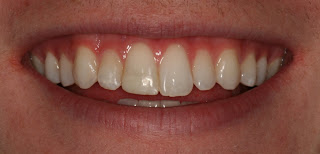


Boulder tooth bonding patient after dental bonding.


Boulder porcelain veneers patient after cosmetic dentistry.


Once a root canal has been performed, the tooth is structurally weakened and prone to fractures and breaking if left as is. In Adam’s case, tooth #8 was crowned not only because of the root canal but because of the fractures caused by the accident. A carbon fiber post was placed on tooth #8 to adequately support the crown so the bite force would be properly distributed so that the tooth did no fracture.


Due to the fractures, teeth #7, 9, and 10 were prepared for porcelain veneers in Boulder dental office of Dr. Adler. A veneer is a thin shell of porcelain that is bonded to a tooth to improve its color or shape. A veneer generally covers only the front and top of a tooth. Veneers can be used to close spaces between teeth, lengthen small or misshapen teeth, or whiten stained or dark teeth. When teeth are fractured, as in Adam’s case, or beginning to wear, veneers can protect them from damage and restore their original appearance.

Cosmetic dentistry in Boulder patient after boulder teeth whitening.


The teeth were prepared for the crown and veneers by removing any damaged areas. The teeth were then shaped to securely hold the crown/veneers. An impression of the teeth were then taken so the dental lab could make an accurate model of Adam’s mouth and then created a crown that precisely fit his mouth and bite. Unlike porcelain fused to metal crowns, all porcelain crowns are translucent and allow light to pass through the tooth like a natural tooth opposed to reflecting all the light which can make the tooth appear dark. Porcelain fused to metal crowns can also have a dark ring near the gum line which is not present with all porcelain crowns. The shade of the teeth is also very important to maintain the natural appearance. An underlying shade is taken of the prepared tooth, known as a stump shade, to better match the natural and subtle hues of the tooth. The shade of the crown made by this Boulder cosmetic dentist is also determined by the adjacent teeth. Whitening was done before this outer shade was taken to make sure the crown closely matched the other teeth and because crowns are not effected by the whitening process and so remain the same color as they are made.


Now Adam has a great new smile that he can’t help but show off and the results are dazzling.


For more information about Teeth Whitening in Boulder Colorado and Cosmetic Dentistry visit Dr. Adler's website at AdlerDentistry.com.

Wednesday, March 26, 2008

Truly Restorative Dentistry - Case Study

Picking up the Pieces

Ryan suffered a traumatic fall that severely damaged his front teeth. Tooth #8 (his upper front tooth on the right) had sustained the most damage and had had a third of the tooth broken off. Ryan was suffering pain and sensitivity due to the fracture. Tooth #9 (located to the left of #8) was also fractured but not to the same extent. After his accident Ryan went to Boulder cosmetc dentist Dr. Michael Adler, DDS to explore his options for treatment.

Denver dental patient's teeth before cosmetic dentist Dr. Adler performed a dental restoration.

Dr. Adler performed a root canal on tooth #8 as part of his emergency treatment to get the patient out of pain. The teeth were temporarily bonded to make the teeth look normal while Ryan was completing his treatment. The root canal was necessary because the severe fracture exposed the pulp of the tooth to bacteria that live in the saliva. If left untreated, the tooth would continue to be a source of infection and eventually weaken the body’s immune system. The pulp is contained within an inner chamber of the tooth called the pulp chamber. Pulp is commonly referred to as the nerve but is actually a soft tissue make up o nerves, arteries, and veins. The pulp extends from the pulp chamber down through narrow channels, called the root canals, to the tips of the roots. The fear and pain associated with root canals are over rated. For most patients, getting a root canal is no more traumatic that having a filling done. During the process of the root canal, the doctor goes into the tooth and removes the pulp, cleaning the cavity.

Once a root canal has been performed, the tooth is structurally weakened and prone to fractures and breaking if left as is. Dental crowns are a common option for a root canalled tooth. In Ryan’s case, both tooth #8 and 9 were both crowned not only because of the root canal but because of the fractures caused by the accident. The teeth are prepared for the crown by removing any damaged areas and/or decay. In the case of tooth #8 a carbon fiber post was placed to adequately support the crown so the bite force would be properly distributed so that the tooth did no fracture. The tooth is then shaped to securely hold the crown. The crown is either custom fabricated in the office using CAD/CAM CEREC system or sent to a laboratory. Ryan’s was sent to a laboratory and an impression of the tooth was taken so the dental lab could make an accurate model of his mouth, and then created a crown that precisely fit his mouth and bite. Ryan received all porcelain crowns on #8 and 9. Unlike porcelain fused to metal crowns, all porcelain crowns are translucent and allow light to pass through the tooth like a natural tooth opposed to reflecting all the light which can make the tooth appear dark. Porcelain fused to metal crowns can also have a dark ring near the gum line which is not present with all porcelain crowns. The shade of the teeth is also very important to maintain the natural appearance. An underlying shade is taken of the prepared tooth, known as a stump shade, to better match the natural and subtle hues of the tooth. The shade of the crown is also determined by the adjacent teeth. Whitening is done before this outer shade is taken to make sure the crown closely matched the other teeth and because crowns are not effected by the whitening process and so will remain the same color as they are made.


Denver dental patient's teeth after cosmetic dentist Dr. Adler performed a dental restoration.

Prior to the crowns being custom made, Ryan had his teeth whitened using our in-office ZOOM laser whitening. The main ingredient in Zoom is hydrogen peroxide, which works by oxygen enter the enamel and dentin was it breaks down. The oxygen bleaches colored substances and doesn’t harm the tooth structure. The Zoom light aids in activating the hydrogen peroxide and helps it penetrate the surface of the tooth. It is a simple procedure that can produce great results. With this new brighter smile, Ryan was ready to have the shade taken and the crowns seated.

The results of Ryan’s treatment were both dramatic and were a great improvement from the post accident appearance. When accidents happen, we are here to help you pick up the pieces.